

The Benefits of Release Writing: How to Safely Empty Your Mind and Recalibrate Your Nervous System
Journaling has been one of the most powerful healing tools in my life.
I truly attribute so much of my emotional growth, clarity, and self-trust to the practice of writing.
But there is one specific form of journaling that I return to again and again:
Release writing
Release writing is the practice of giving yourself full permission to express your thoughts and emotions in an unfiltered, uncensored way — without worrying about grammar, politeness, or how it sounds.
It is not about insight, although that may occur….
It is about release.
What Is Release Writing?
Release writing is emotional clearing on paper.
It is the space where you write what you cannot say out loud.
What feels too messy.
Too angry.
Too confusing.
Too honest.
It is the container for:
-
Anger
-
Resentment
-
Grief
-
Frustration
-
Fear
-
Overwhelm
-
Unspoken thoughts
-
Unprocessed experiences
Instead of suppressing these emotions (which often leads to tension, anxiety, or eventual burnout), you give them a safe outlet.
Because when emotions don’t have a healthy place to go, they tend to surface in unhealthy ways, and at inconvenient times.
Release writing gives your emotional energy movement.
And movement creates relief.
The Nervous System Benefit
Releasing is an integral part of recalibrating the nervous system.
When we hold in thoughts and emotions, the body stays activated. The mind loops. The heart tightens. We stay in a subtle state of fight, flight, or freeze.
Writing without censorship allows the nervous system to discharge stored activation.
It signals safety.
It says:
“I am allowed to feel this.”
“I am allowed to express this.”
“I am safe to let this move.”
And that safety is everything.
Why the “Rip It Up” Step Matters
One of the most important parts of release writing is knowing that no one will ever read what you write.
Before you begin, decide:
This page will be destroyed.
You can:
-
Rip it into pieces
-
Shred it
-
Tear it up and discard it
-
Or burn it (if that feels supportive and safe)
Fire can feel powerful because it symbolizes transformation and transmutation. I don’t burn pages daily, but when I do, it becomes a simple ritual of release.
The key is not the drama.
It is the safety.
When you know your words will never be seen, you give yourself full permission to tell the truth.
Authentic release requires safety.
You create that safety for yourself.
My Personal Process
When I release write, I tear a page out of my spiral-bound journal before I even begin. That way I know this page is not staying.
I start writing with no filter.
Often, I begin with the simple prompt:
“I feel…”
And I let the pen move.
As I write, emotions flow. Thoughts unravel. Sometimes clarity surfaces.
If I uncover an insight worth keeping, I write that in my main journal — the pages that remain.
This is important:
Release writing clears the surface.
Insight emerges underneath.
Think of release writing as the doorway.
It helps you get to the deeper truths.
The Deeper Benefits of Release Writing
Over time, this practice supports:
-
Emotional regulation
-
Nervous system recalibration
-
Increased self-awareness
-
Stronger internal trust
-
Clearer intuitive access
-
Integration of inner child wounds
-
Reduced mental rumination
-
Greater emotional honesty
Release writing is not just venting.
It is creating movement where there has been stagnation.
And sometimes, stagnation turns into accumulation — emotionally, mentally, and even physically.
Movement restores flow.
Flow restores clarity.
Journaling as a Healing Tool
All journaling, at its core, is about spending time with yourself and deepening your intuitive relationship with your inner-self.
It is about building internal trust.
Opening the pathway to your intuition.
Giving your emotions a voice.
Creating integration between your heart and your mind.
And one of the best things about journaling…is that it is free!
It requires nothing more than paper, a pen, and willingness.
Where to Begin
If you’re new to release writing, start simple.
Take a blank page and write:
“I feel…”
And keep going.
Don’t edit.
Don’t fix.
Don’t judge.
Try to write for 1-2 pages, although as your practice deepens you may find yourself doing 1-4 pages.
When you’re finished, tear it up.
Let that be enough.
Want to Go Deeper?
Release writing is one of the foundational practices I teach inside my journaling work.
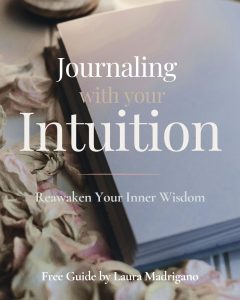
If you’d like guidance on strengthening your intuitive connection and building a consistent practice, I invite you to download my free guide:
Journaling With Your Intuition — A Guide to Help You Reconnect with the Wisdom of Your Soul.
And if you’re ready for structured, daily support, my course
7 Days to Ignite Your Intuition
walks you step-by-step through release writing and the deeper practices that follow.
Sometimes clarity doesn’t come from thinking harder, It comes from letting go.