
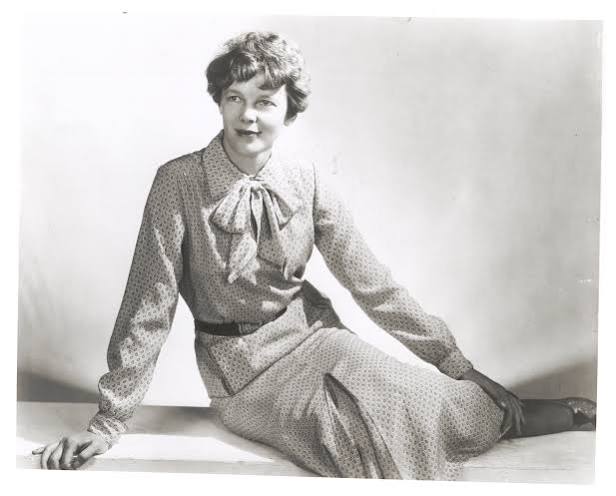
Couture in the Cockpit: Inside Amelia Earhart’s Revolutionary 1933 Fashion Line (Part 2)
Last week, we opened the curtain on a side of Amelia Earhart the history books completely ignored, framing her not just as a pilot, but as a master of personal branding and visual alignment. While the modern expedition crew continues their high-tech search in the South Pacific lagoon, today we are stepping directly into her design studio.
Most people know Amelia for her aviation records, but few realize that in late 1933, she took the fashion capitals of New York, Chicago, and San Francisco by storm.
She didn’t just lend her famous name to a label for a quick endorsement paycheck; Amelia was the hands-on Creative Director of her own fashion house. Her venture, Amelia Earhart Fashions, was a brilliant masterclass in “functional couture” engineered explicitly for the lifestyle of the modern, active woman.
The Atelier in Suite 803
Amelia’s design process began with a spark of high-fashion inspiration. After meeting the legendary Italian surrealist couturier Elsa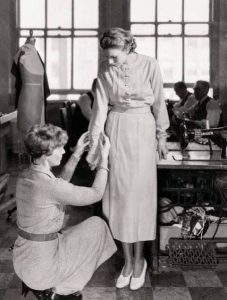 Schiaparelli, the two women bonded over a shared philosophy: clothing should liberate a woman’s movement, not restrict it.
Schiaparelli, the two women bonded over a shared philosophy: clothing should liberate a woman’s movement, not restrict it.Inspired, Amelia and her husband turned Suite 803 at the Hotel Seymour in New York City into a startup fashion atelier.
The workspace was beautifully chaotic, tables buried under bolts of premium textiles, a single dressmaker’s mannequin, one sewing machine, and a single hired seamstress. Having sewn her own clothes as a resourceful teenager, Amelia personally draped fabrics, sketched the blueprints, and pattern-drafted the templates. She was tailoring an entirely new look for the independent woman.
The Architecture of Women’s Closets: Her Style Innovations
Amelia approached clothing design like an engineer. She noticed the everyday wardrobe frustrations women faced in the 1930s and completely redesigned the architecture of their garments:
-
- The Invention of “Separates”: Historically, women had to purchase suits and outfits as pre-matched pairs of the exact same size. Amelia changed everything by marketing tops and bottoms individually. This revolutionary concept allowed creative women with varied proportions to buy a size 6 blouse and a size 10 skirt without paying for custom tailoring.
- The “Menswear” Shirt-Tail: Frustrated that women’s blouses constantly rode up and came untucked during activity, Amelia
 borrowed a pattern trick from men’s tailoring, extending the back tails of her shirts so they stayed securely in place.
 - Aviation Materials: She brought the sky to the sewing machine, utilizing wrinkle-free, washable wools, weather-resistant Grenfell cotton, and genuine parachute silk.
- Industrial Hardware Accessories: In a stroke of absolute branding genius, her garments featured buttons shaped like propellers, fasteners crafted from real airplane wing bolts, and belt buckles made from industrial ball-bearings.
The Retail Phenomenon
Amelia bypassed small dress shops and went straight for the giants of luxury retail. Amelia Earhart Fashions made its grand debut at R.H.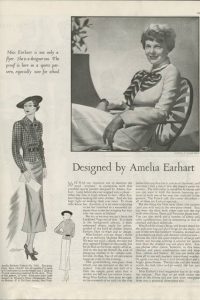 Macy & Co. in New York City.
Macy & Co. in New York City.The collection was a massive success, expanding into 30 premier department stores nationwide, including Marshall Field’s in Chicago and The Emporium in San Francisco. Stores didn’t just place her clothes on standard racks; they built dedicated, standalone Amelia Earhart boutique shops inside their buildings.
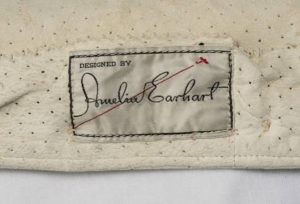
Every single piece bore a stunning woven label featuring Amelia’s personal signature, dynamically crossed by a bright red monoplane darting across the fabric.
The Business Coaching Lesson Behind the Seams
Though she was named one of the “Ten Best-Dressed Women in America” in 1934, the fashion line lasted only a single season. The harsh economic realities of the Great Depression dried up luxury retail traffic. Ironically, her own brilliant innovation of mix-and-match separates meant women bought fewer total items because they could style one piece multiple ways!
But a true pioneer never lets a closed door stop her journey. When the commercial line wrapped up, Amelia pivoted. She published her exact clothing patterns directly in Woman’s Home Companion magazine so everyday women could sew her couture designs at home for pennies.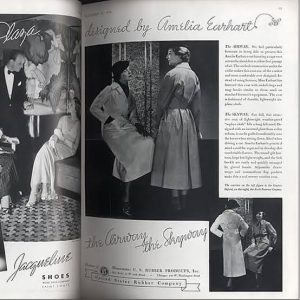
Amelia understood a core truth that I coach my clients on every single day: when your external environment shifts, you don’t abandon your vision, you change your distribution. She streamlined her approach, expanded her reach, and ensured her message of feminine independence reached the women who needed it most.
Next week, in the final installment of our series, we will bring this journey full circle. We will explore the haunting physical artifacts found on her lost island, from her personal cosmetics to a pocket knife matching her plane’s inventory, and look at the final real-time verdicts from the current Purdue expedition.
Which of Amelia’s design innovations do you wish was standard in your closet today? I’d love to hear your thoughts in the comments!